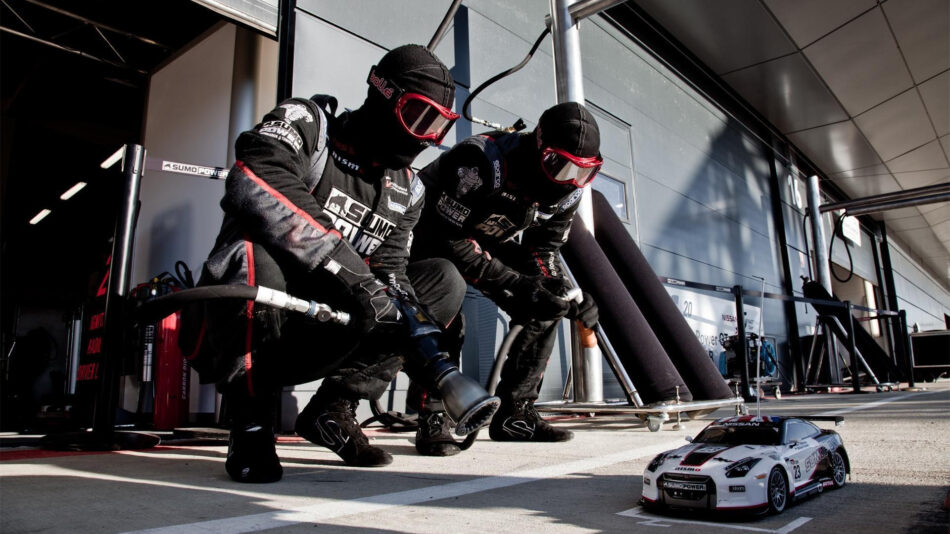
This question answer format is designed for beginners and will attempt to answer questions, correct misconceptions, and generally ease entry into the rapidly growing hobby, sport of R/C cars. We welcome your questions, as answers to representative questions will help other beginners.
Q: What is radio control (RC)?
A: Radio control is an electronic method of remote control. Basically, encoded signals arc transmitted by a hand-held transmitter and are in turn decoded by a receiver some distance away. These transmitted signals are sent and recognized as some position of steering or speed rate in a vehicle. A full explanation of RC is well beyond the scope of this column. RC is used to control cars, airplanes, helicopters, boats, and even robots.
Q: How fast do radio control cars go?
A: The speed depends on car type and power. There are two power types, gas and electric. Electric-powered cars use rechargeable batteries and electric motors to reach speeds of 15 to 40 miles an hour. Gas cars use a single cylinder engine burning model engine fuel—a methanol-based fuel and they arc faster than electric cars.
Q: Do I need a license to operate a radio control system?
A: No. licenses are no longer required.
Q: What kind of car should I buy?
A: You must first decide on your own favored style: dune buggy, high-speed sports car, off-road trucks— virtually every style is available in kitted form. The next decision is based on where you can run your car. You will need a very flat, clear, and smooth place to run track-style sports cars—paved parking areas, industrial parks, school yards, gymnasiums or tracks operated by hobby shops or clubs. If no such place is nearby, you might wish to start with a dune buggy, off-road vehicle, four-wheel drive truck, tractor, or even a military tank—all can operate on relatively rough surfaces, even your lawn or backyard.
Q: What kind of radio control system should I buy?
A: Check the manufacturer s recommendation for your car and then use good shopping sense to buy a system, one which will get you the best price and service. A two-channel, two-stick system is most popular. Each channel provides a separate control function, with a two-channel system giving steering and speed control. With two sticks on the transmitter face, the right stick usually is used for steering while the left stick controls throttle. Most electric cars have forward and reverse; gas cars usually do not have reverse. A throttle stick can be used to control forward and reverse as well as speed. There are wheel control systems best suited for people interested in competitive racing. The wheel takes the steering stick’s place for finer control and is often more expensive with features useless to beginners.
Q: What other kinds of accessories will I need to build and operate an RC car?
A: My recommendations are the following items: a modeler’s tool set. model paint and supplies, a tool box for tools and spare parts and some items such as a soldering iron with electrical solder, electrical tape and the appropriate glues recommended by the kit manufacturer. In many cases, the kit manufacturer will give a list of tools for each car’s assembly.
Q: What are the advantages of electric cars versus gas cars?
A: Electric cars are cleaner and quieter to operate since they use rechargeable nickel-cadmium batteries and electric motors for power. The electric car often has forward and reverse speeds, and can operate in somewhat rougher terrain. However, support equipment, such as chargers for the batteries, can be expensive, and electric motors arc subject to burn-out and cannot produce as much power as a gas engine. Gas cars are often faster and produce more hill-climbing and road-flattening power, but require model engine fuel and starting equipment. They also might not have reverse, are noisier, and need more periodic cleaning for continued good operation. At the present time, electric off-road cars are most popular because of their simple assembly and operation, and ability to run on driveways, dirt paths, and other rough surfaces. Gas cars have been around a long time, and I think that gas off-road cars in 1/10-and 1/8-scales will slowly rise in popularity.